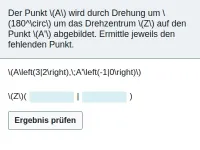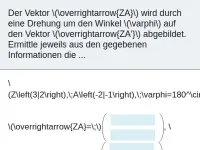
Wie verändern sich die Koordinaten eines Vektors bei einer Drehung um 90°?
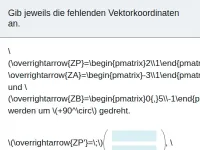
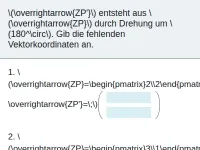
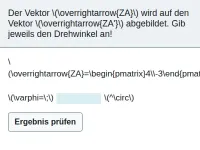
Dreht man den Vektor \(\overrightarrow{ZA}\) um \(90^\circ\) gegen den Uhrzeigersinn \((\varphi=+90^\circ)\) um das Zentrum \(Z\), so wird er auf den Vektor \(\overrightarrow{ZA'}\) abgebildet. Für die Vektorkoordinaten gilt:
\(\overrightarrow{ZA}=\begin{pmatrix} x\\y \end{pmatrix} \Rightarrow \overrightarrow{ZA'}=\begin{pmatrix} -y\\x \end{pmatrix}\), also zum Beispiel \(\overrightarrow{ZA}=\begin{pmatrix} 5\\1 \end{pmatrix} \Rightarrow \overrightarrow{ZA'}=\begin{pmatrix} -1\\5 \end{pmatrix}\)
Dreht man hingegen um \(90^\circ\) mit dem Uhrzeigersinn \((\varphi=-90^\circ)\), so gilt:
\(\overrightarrow{ZA}=\begin{pmatrix} x\\y \end{pmatrix} \Rightarrow \overrightarrow{ZA'}=\begin{pmatrix} y\\-x \end{pmatrix}\), also zum Beispiel \(\overrightarrow{ZA}=\begin{pmatrix} 3\\1 \end{pmatrix} \Rightarrow \overrightarrow{ZA'}=\begin{pmatrix} 1\\-3 \end{pmatrix}\)
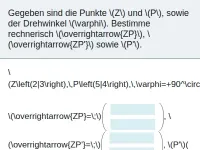
\(Z\left(1|2\right),\,P\left(3|4\right),\,\varphi=90^\circ\)
2. Da um \(+90^\circ\) gedreht wird gilt: \(\overrightarrow{ZP}=\begin{pmatrix} x\\y \end{pmatrix} \Rightarrow \overrightarrow{ZP'}=\begin{pmatrix} -y\\x \end{pmatrix}\). Also: \(\underline{\overrightarrow{ZP'}=\begin{pmatrix}-2\\2\end{pmatrix}}\)
3. Es gilt: \(\overrightarrow{ZP'}=\overrightarrow{OP'}-\overrightarrow{OZ}\Rightarrow \overrightarrow{OP'}=\overrightarrow{ZP'}+\overrightarrow{OZ}=\)
\(=\begin{pmatrix}-2\\2\end{pmatrix}+\begin{pmatrix}1\\2\end{pmatrix}=\begin{pmatrix}-1\\4\end{pmatrix}\Rightarrow \underline{P'\left(-1|4\right)}\)